
Rising Hope in the Camps of Exile
In the vast refugee settlements of Cox’s Bazar, where nearly 1.3 million Rohingya have endured statelessness since fleeing military crackdowns in Myanmar in 2017, hope is a rare and fragile thing. For a people stripped of citizenship, denied a homeland, and persecuted for their faith, most days are marked by survival, not optimism.

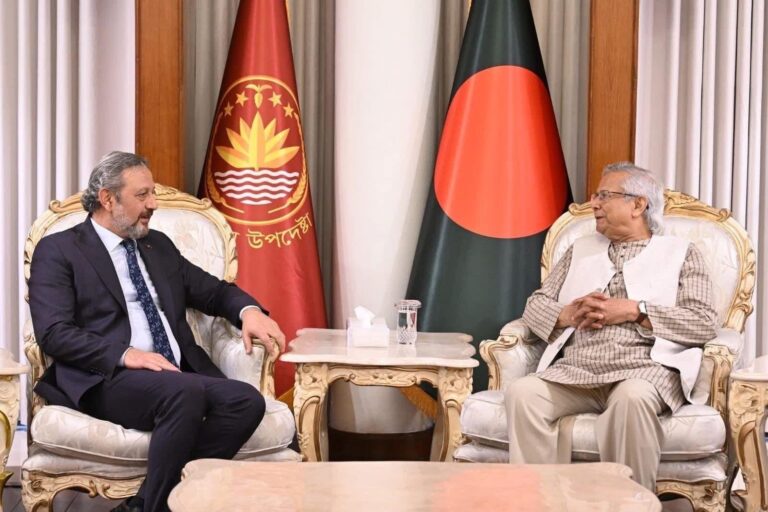
Fig: Mehmet Akif Yılmaz and Dr. Yunus
On 4 November 2025, a five-member Turkish parliamentary delegation, led by Mehmet Akif Yılmaz, chair of the Türkiye–Bangladesh Parliamentary Friendship Group, visited the camps and witnessed the Rohingya’s struggle. The Rohingya community expressed their deepest gratitude for the visit.
That same evening in Dhaka, the delegation met with Bangladesh’s Chief Adviser, Dr. Muhammad Yunus, whose words cut through years of diplomatic caution and show’s exact reason of rohingya’s being persecution.
“The plight of the Rohingya community remains one of the most tragic humanitarian crises of our time. These people are suffering simply because they are Muslims, and their citizenship has been stripped away.”
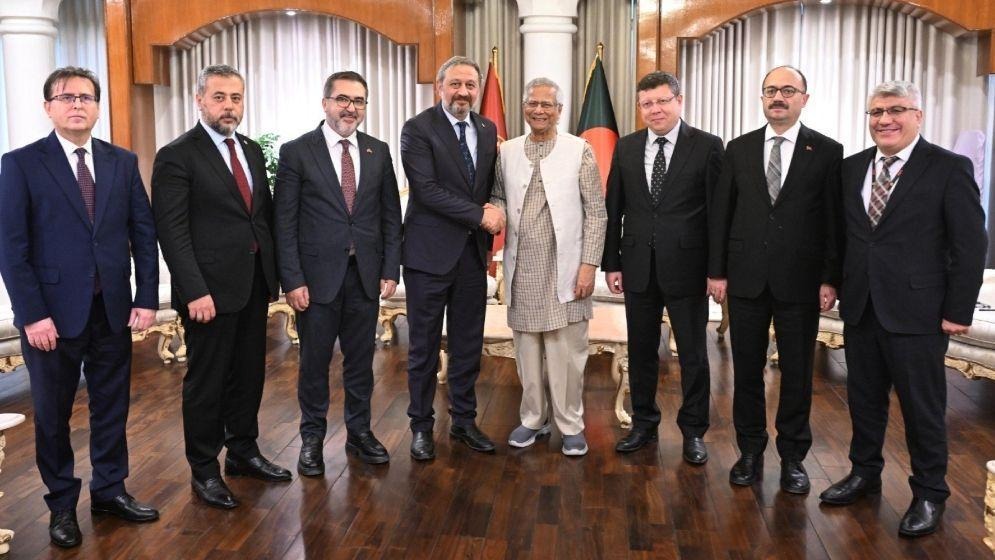
Fig: Dr. Yunus with Turkish parliamentary delegation
Dr. Yunus also thanks President Recep Tayyip Erdoğan and First Lady Emine Erdoğan for their “continued support and solidarity with Bangladesh, particularly in humanitarian and development cooperation.” Pointing to growing cooperation in trade, investment, and humanitarian aid, he said
“Since assuming this responsibility, I have focused on further deepening our close relationship with Türkiye,”
This visit break through the numbness of waiting. They remind us that our struggle is not invisible, that our faith is not a crime, and that our return to Arakan is still a goal worth fighting for.
A Bond Forged in Sincerity: Türkiye’s Legacy of Standing with the Rohingya
Türkiye’s engagement with the Rohingya crisis began long before it gained consistent international attention. In August 2012, during one of the earliest waves of targeted violence against Rohingya civilians in Arakan (Rakhine) State, a high-level Turkish delegation became the first foreign group to visit the affected communities on the ground. The delegation included First Lady Emine Erdoğan, her daughter Sümeyye Erdoğan, then Foreign Minister Ahmet Davutoğlu, his wife Dr. Sare Davutoğlu, as well as senior officials from the Turkish Red Crescent and other Turkish humanitarian organizations to visit displaced Rohingya communities inside the country.
At a time when entire villages were being burned and Rohingya civilians killed, their visit carried deep symbolic and political weight. The delegation toured Banduba (Baw Du Pha) Camp near Sittwe, where Emine Erdoğan personally met with Rohingya families, listened to survivors, and helped distribute aid. Witnesses recall her emotional reaction, particularly when she embraced widows and orphaned children, a moment that left a lasting imprint. Since then, Rohingya community have referred to her respectfully as the “mother of the Rohingya nation.”
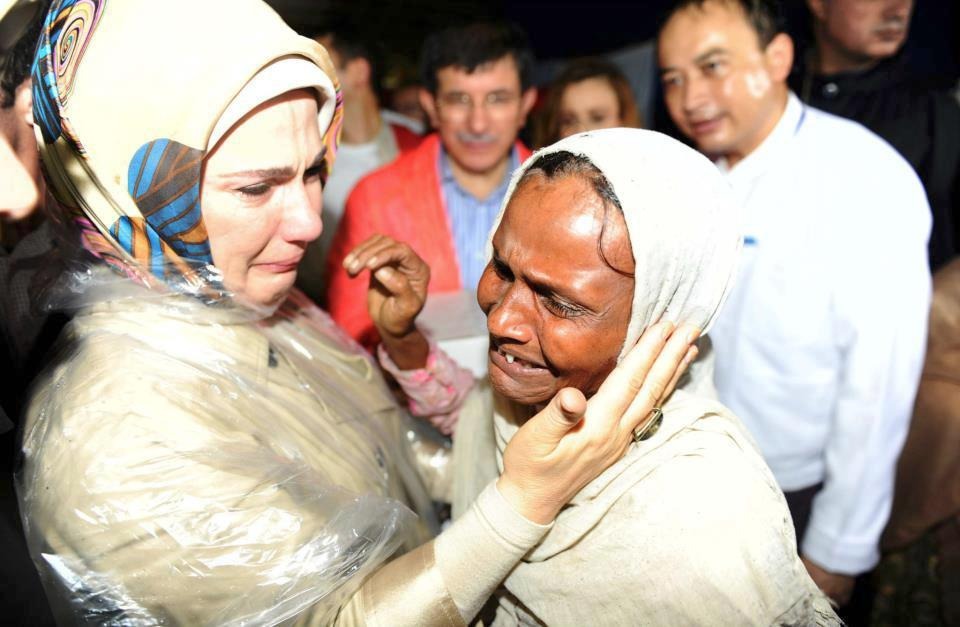
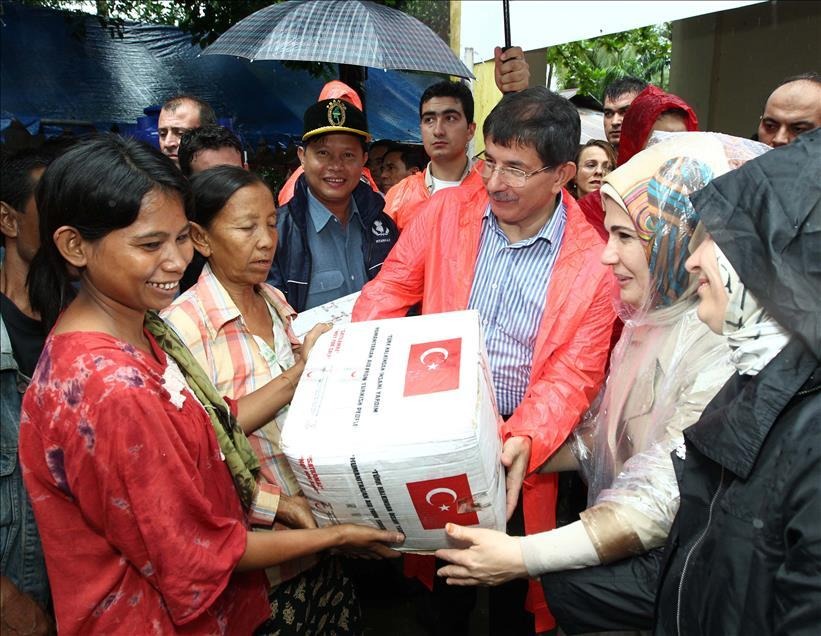
In September 2017, as violence escalated once again and over A Milion Rohingya fled to Bangladesh, Emine Erdoğan returned — this time visiting the Cox’s Bazar refugee camps. Her visit on 6–7 September came at a critical moment, just weeks into the mass exodus. She was accompanied by Foreign Minister Mevlüt Çavuşoğlu, and led Türkiye’s international response to the crisis from the Bangladesh front.
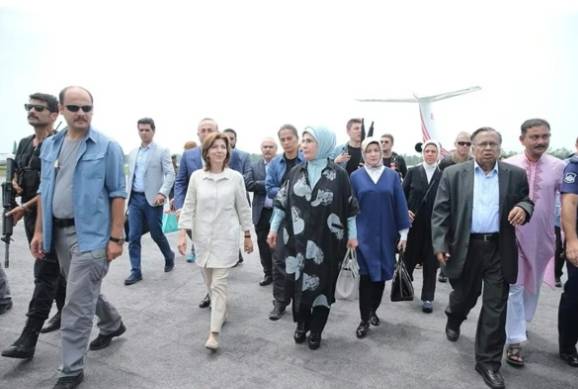
Together, they assessed conditions on the ground, met with newly arrived refugees, and helped coordinate the distribution of emergency aid. Their presence helped elevate the crisis on international platforms, while reinforcing Türkiye’s humanitarian stance and its calls for international accountability.
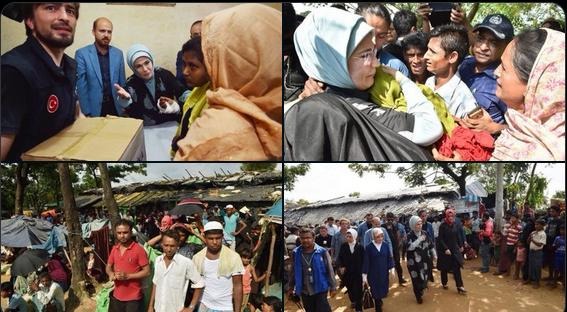
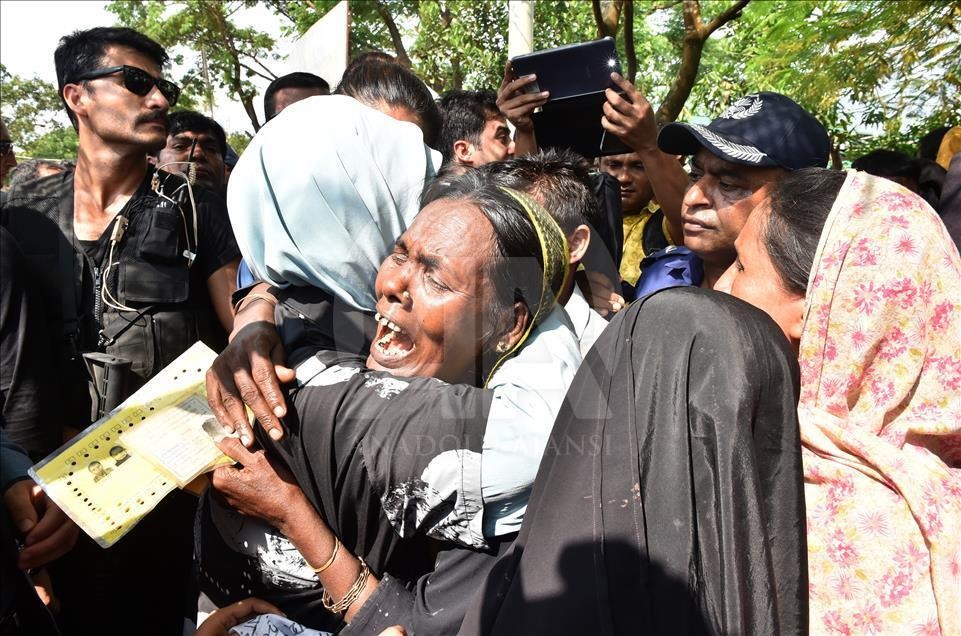
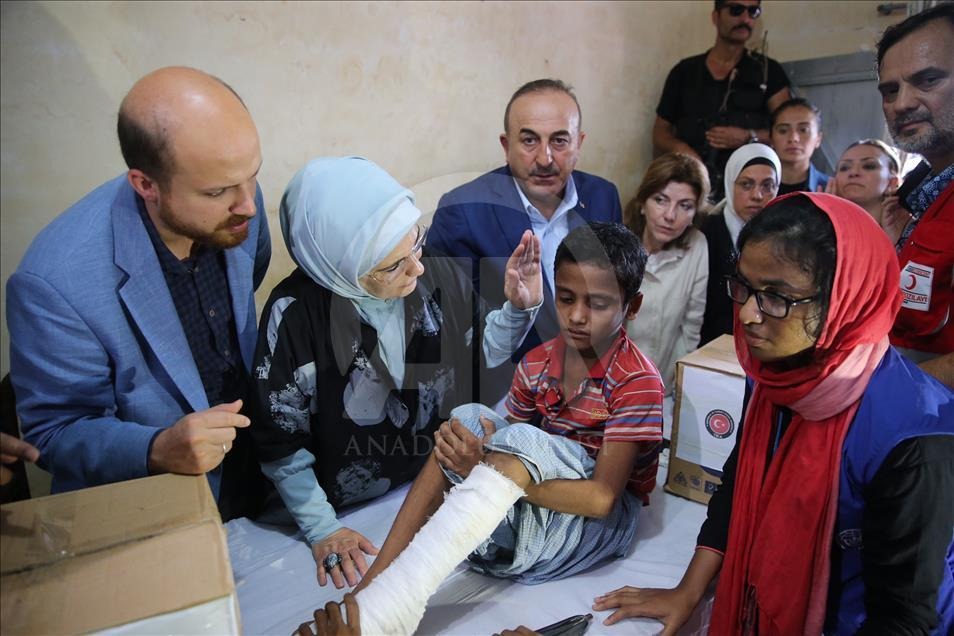
In December 2017, Turkish Prime Minister Binali Yıldırım visited Bangladesh on 19–20 December ccompanied by his daughter Büşra Koylubay and Minister of Family and Social Policies Fatma Betül Sayan Kaya. , including direct engagement with Rohingya camps in Cox’s Bazar. During the visit, Yıldırım described the killings of Rohingya in Myanmar as “one kind of a genocide”. He inspected the humanitarian facilities.
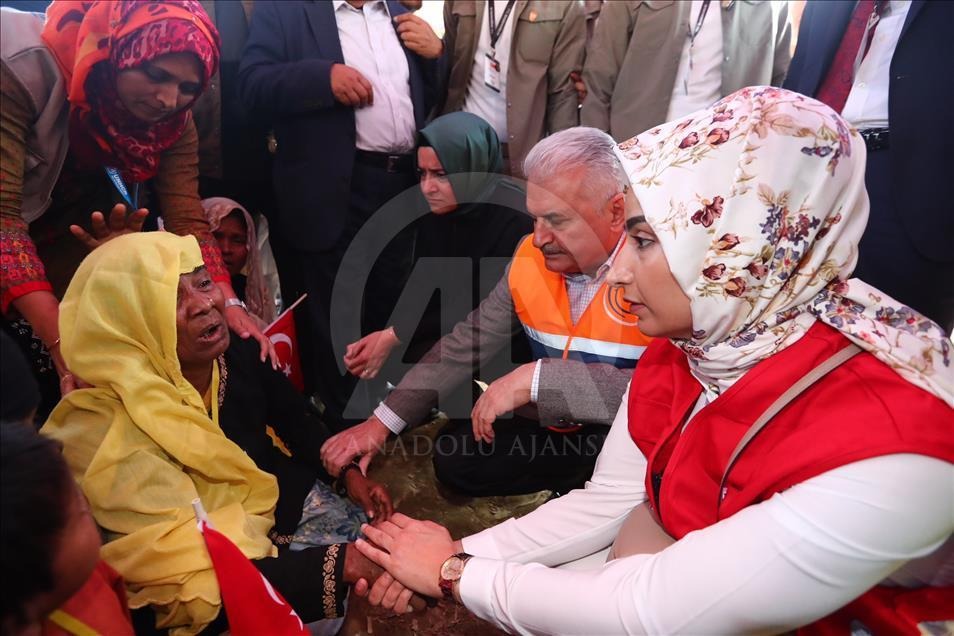
Fig: Prime Minister of Turkey Binali Yildirim (2 R)
At the above fig, Prime Minister of Turkey Binali Yildirim (2 R), his daughter Busra Koylubay (R) and Turkish Minister of Family and Social Policies Fatma Betul Sayan Kaya (3 R) listen to a Rohingya woman as she cries, at Balukhali camp during their visit at Rohingya camps in Cox’s Bazar, Bangladesh on December 20, 2017.
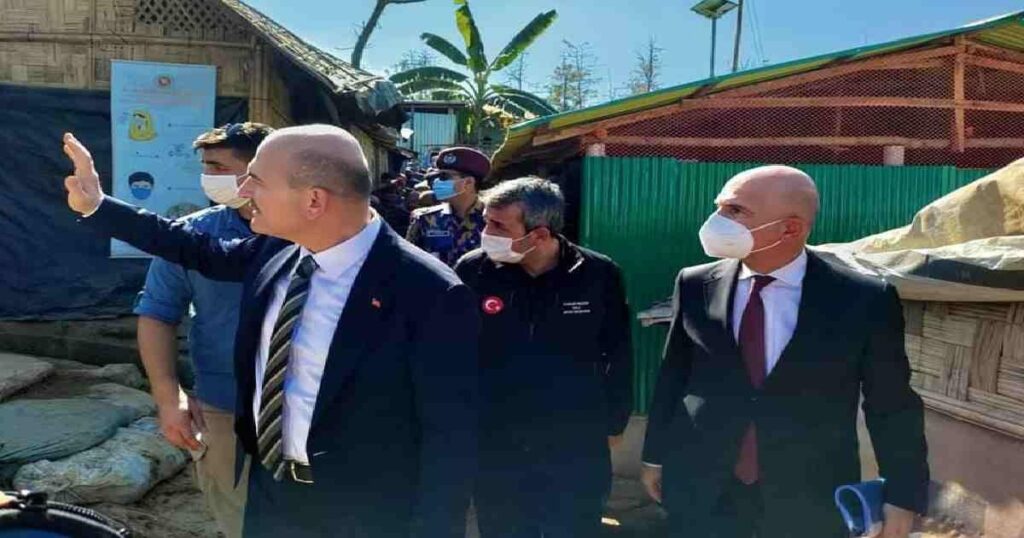
In January 2022, Türkiye reaffirmed its sustained engagement when Interior Minister Süleyman Soylu visited the Rohingya camps in Bangladesh. During his visit on 8 January, he met with local officials, humanitarian workers, and camp authorities. Addressing the media, he publicly stated that “Bangladesh is not alone in tackling the Rohingya crisis,” and reiterated Türkiye’s long-term commitment to support both Bangladesh and the displaced Rohingya population.
These successive visits — spanning over a decade — reflect a consistent policy approach by Türkiye: combining political visibility, high-level
diplomacy, and direct humanitarian presence. From Sittwe to Cox’s Bazar, Türkiye remains one of the few countries whose leadership has stood physically and repeatedly beside the Rohingya people.
Over the years, Türkiye’s role has gone beyond diplomatic gestures. Institutions such as the Turkish Red Crescent, TIKA, IHH, and the Diyanet Foundation have maintained long-term engagement on the ground — delivering food, healthcare, shelter, and spiritual support.
Appreciating Those Who Walked With Us
The Rohingya community expresses sincere appreciation to the members of the Turkish parliamentary delegation, led by Mehmet Akif Yılmaz, Chair of the Türkiye–Bangladesh Parliamentary Friendship Group. Their visit to the camps was not a symbolic appearance. Delegates engaged directly with local communities, observed the humanitarian situation firsthand, and demonstrated a willingness to listen. Such gestures, while simple, carry significance in a context where many global actors have remained distant.
We also extend our gratitude to the Bangladeshi authorities involved in facilitating this visit, and to those who continue to manage the day-to-day realities of hosting one of the world’s largest refugee populations. Coordinating assistance for nearly 1.3 million people — across health, security, and infrastructure — is a complex and often underappreciated effort. The Rohingya community acknowledges this burden and the support extended to us over the years.
The Path Forward: Repatriation with Dignity, Not Prolonged Charity
There is a clear understanding among the Rohingya: the refugee camps are not a permanent solution. Children born in exile, elders aging without status, and families separated from their homeland cannot remain indefinitely in temporary shelters. The objective has never been long-term dependency — it has always been a safe, voluntary, and dignified return to Arakan.
In this context, growing cooperation between Türkiye and Bangladesh presents a meaningful opportunity. Their engagement — rooted in shared religious, humanitarian, and regional concerns — can help shape a more structured international approach to the crisis. Their partnership sends a message that accountability, not complacency, should define the next phase of the response.
We urge the international community to recognize that the responsibility for this crisis cannot rest solely on Bangladesh. The consequences of Myanmar’s actions are global, and so must be the response. Repatriation cannot remain a political talking point. It must be operationalized through clear timelines, sustained diplomatic pressure, and guarantees of safety, rights, and recognition upon return.
The Rohingya do not seek special treatment. We seek what any displaced people deserve: the chance to go home , safely, with dignity, and with our identity intact.
We Are Still Here: A Closing From the Heart of a People
To the international community, we say this plainly: the Rohingya are still here. We remain stateless, but not silent. All we seek is justice and right to return our homeland with dignity.
We remember those who stood with us. We also remember those who chose not to. In time, history will account for both.
The recent show of sincerity from Türkiye, the honesty and moral clarity of Dr. Muhammad Yunus, and the continued hosting by Bangladesh have brought back something rare among our people — a sense of renewed hope.
We strongly believe one day we will return to our homeland.
We strongly believe one day our children will grow up with identity, not numbers.
We strongly believe one day our dead will not be lost to silence.
Even in exile, the Rohingya have not given up.We have truth. And we have the collective will to hold on — until return, and until justice.