
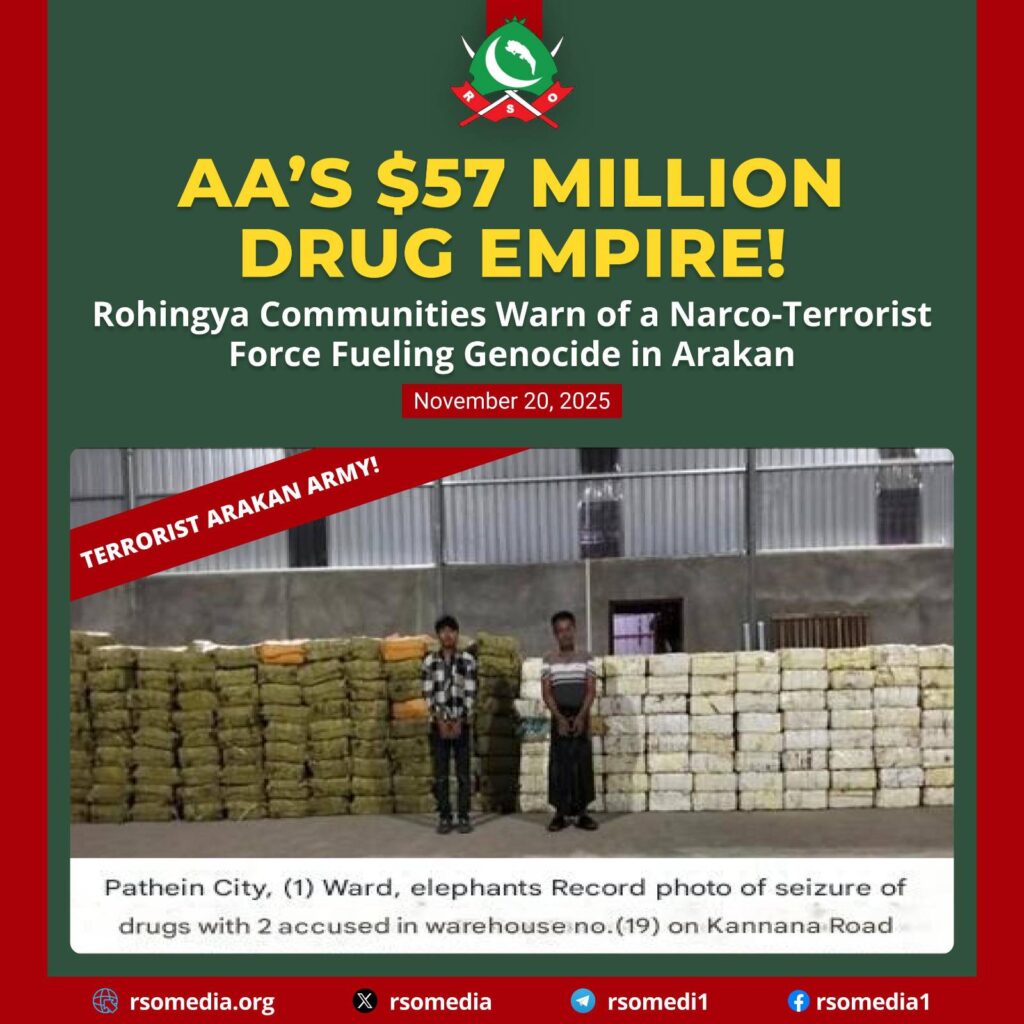
A major narcotics seizure in early November 2025 has confirmed what Rohingya communities and the RSO have long warned: the Arakan Army (AA) has transformed into one of Southeast Asia’s most dangerous narco-terrorist organizations. The recovery of 4,000 kg of high-purity crystal methamphetamine (ICE), worth 57.1 million USD, was documented through field-based logs and maritime inspection records. Far from being an “ethnic resistance movement,” AA today operates as a transnational drug mafia, weaponizing narcotics revenue to brutalize Rohingya communities, expand armed capabilities, and entrench its domination across Arakan.
AA: A Cartel Disguised as a Resistance Group
For years, Rohingya civilians in Maungdaw and Buthidaung have witnessed AA’s involvement in meth production, extortion, and the trafficking of opium, yaba, and crystal meth. This latest evidence exposes the scale of that criminal enterprise. AA’s operational budget is driven not by political aspiration but by a Bilion-dollar drug economy, one directly linked to attacks, mass displacement, and systematic Genocide of Rohingya populations.
The seizure took place beneath Warehouse No. 19 in Pathein, Ayeyarwady Region, where ICE was concealed in modified tanker compartments used by transnational crime groups. Interrogation notes and movement logs show AA operatives embedded throughout the Ayeyarwady coastal belt (Pathein, Chaung Tha), the Yangon commercial network, and the Tanintharyi maritime corridor (Myeik, Kyunsu), forming a unified route from northern Shan State down to the Bay of Bengal.

Among the arrested were AA operative Khin Htun, Pathein custodian La Min Khant, and multiple logistics and vessel personnel. The recovery of U.S.-made rifles, pistols, and ammunition underscores how drug profits are being converted directly into weapons used against Rohingya civilians.


From Producers to Paid Couriers of Multiple Drug Syndicates
Investigative findings confirm the meth originated from long-established drug hubs in Shan State, managed by cartel controllers such as A Wai (Xiao Thang/Than Maung) and Takaw. Shipments moved through Kyethi and Loilyn before being transferred to AA’s courier network, which now acts as a regional logistics service for multiple drug syndicates, transporting both synthetic drugs and raw opium for commission.
AA’s expanding grip over the Bay of Bengal coastline has made them a preferred transit partner for traffickers seeking discreet maritime routes. Modified oil tankers with hidden compartments were used to move the drugs to Pathein before offshore distribution.

From the coastal hubs, the ICE load was split into two routes:
(a) Toward Malaysia, Indonesia, and Singapore—handled by trafficker Maung Nge, with only top-grade ICE entering Singapore;
(b) Toward Arakan State, a secondary staging ground managed by AA’s own handler, Khin Htun, for further international export.
This system reflects a cartel-level, professionally structured infrastructure, not the work of opportunistic smugglers.

Drug Money Financing Genocide
AA’s narcotics empire now represents a direct threat to regional security—and an existential threat to Rohingya communities. Drug revenue is directly reinvested into:
Weapons and ammunition used in attacks on Rohingya villages
Forced disappearances, population engineering, and land seizures
Surveillance networks designed to control and intimidate Rohingya
The expansion of AA’s parallel governance system built on coercion
AA’s narco-financing strengthens trafficking syndicates across ASEAN, increases meth circulation in Asian cities, and destabilizes maritime security in the Bay of Bengal.
RSO’s Call to the International Community
For years, RSO and Rohingya civilians have warned that AA is not a liberation force,it is a narco-militia sustaining itself through genocide, extortion, and drug trafficking. The 57 million USD seizure is not an anomaly; it is a window into their true identity.
If the world fails to act, AA’s drug-funded war machine will continue to devastate Rohingya communities while undermining regional stability.
The international community, especially ASEAN, OIC, UNODC, and Indo-Pacific security partners—must impose targeted sanctions on AA’s financial channels, commanders, intermediaries, and front companies. Failure to disrupt this ecosystem will embolden AA’s criminal structure, deepen the crisis in Arakan, and accelerate narco-terrorist expansion across the Bay of Bengal.