
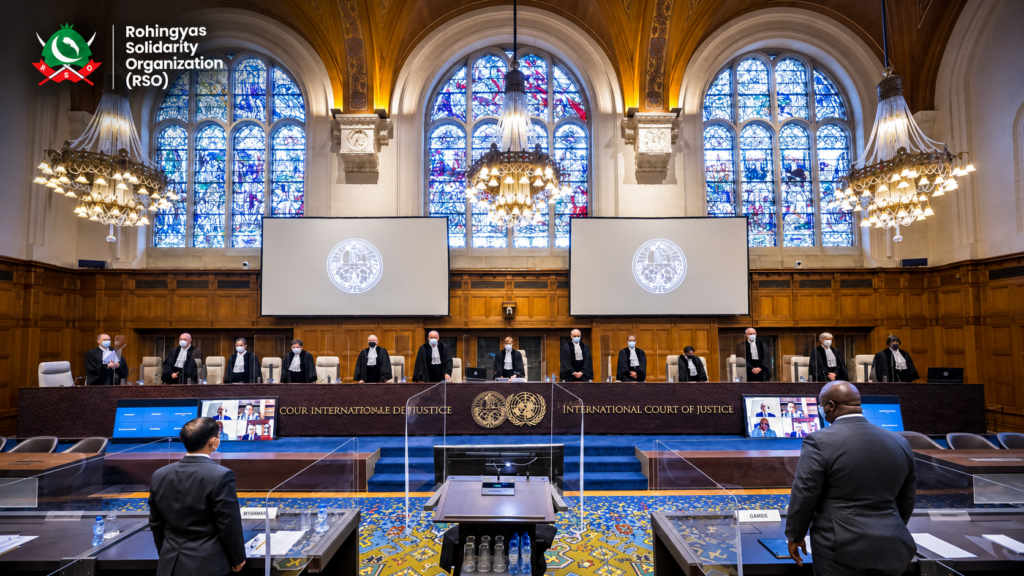
RSO WELCOMES HISTORIC VERDICT, DEMANDS FULL ACCOUNTABILITY, AND CALLS FOR INTERNATIONAL CRIMINAL PROCEEDINGS AGAINST ARAKAN ARMY PERPETRATORS
Official Statement of the Rohingya Solidarity Organisation (RSO)
19 November 2026 | The Hague, Netherlands
OUR DEEPEST GRATITUDE TO THE GAMBIA, BANGLADESH, THE ICJ, AND THE MUSLIM WORLD
The Rohingya Solidarity Organisation (RSO) expresses its profound gratitude to the Republic of The Gambia, Bangladesh, the International Court of Justice (ICJ), the Organisation of Islamic Cooperation (OIC), and every government, institution, legal professional, and human rights defender who stood beside the Rohingya people in their long struggle for justice.
We particularly honor The Gambia, its Government, former Justice Minister Abubacarr Tambadou, Justice Minister Dawda Jallow, and its legal representatives for pursuing this case with exceptional determination since 2019.
We express our deepest gratitude to the Government and people of Bangladesh for sheltering over one million Rohingya, saving countless lives, and providing vital humanitarian support. We particularly recognize Bangladesh’s financial contribution to The Gambia’s historic ICJ case, its diplomatic efforts for international accountability, and its assistance in documenting Rohingya genocide testimonies and bringing these atrocities to global attention.
Our special appreciation extends to Saudi Arabia, Türkiye, Pakistan, Malaysia, Nigeria, and the Maldives for their contributions to the international justice effort. We also recognize the wider diplomatic and humanitarian solidarity of Pakistan, Indonesia, Qatar, and other OIC member states.
We acknowledge the important contributions of Canada, Denmark, France, Germany, the Netherlands, the United Kingdom, Belgium, Ireland, Slovenia, and the Democratic Republic of the Congo, alongside the Maldives, through their formal interventions before the Court.
Above all, we honor the Rohingya survivors whose testimony, suffering, and perseverance made it impossible for the world to bury the truth.
The Gambia stood for justice when the Rohingya had been denied justice. Today, history records the significance of that courage.
THE WORLD’S HIGHEST COURT HAS FOUND MYANMAR RESPONSIBLE FOR GENOCIDE
On 19 November 2026, the International Court of Justice delivered a landmark final judgment in The Gambia v. Myanmar, finding, by nine votes to six, that Myanmar committed genocide against the Rohingya in northern Arakan (Rakhine State).
The judgment establishes Myanmar’s responsibility under the 1948 Convention on the Prevention and Punishment of the Crime of Genocide.
For the first time in its history, the ICJ has found a state responsible for committing genocide.
This is not an allegation awaiting international recognition. It is a final, legally binding determination of state responsibility.
Myanmar’s denial has been confronted by judicial findings. Its military’s actions have been judged against international law—and found to constitute genocide.
THE COURT EXPOSED THE SCALE OF THE KILLINGS
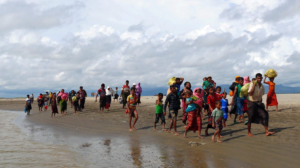
The ICJ found that Myanmar’s security forces killed thousands of Rohingya civilians during the 2016–2017 military operations. Evidence considered by the Court indicated approximately 10,000 Rohingya were killed during the 2017 atrocities.
The Court identified mass executions of Rohingya men and boys, attacks on defenseless civilians, and violence directed at people attempting to escape to Bangladesh.
Entire communities were devastated. Families were destroyed. Hundreds of villages were burned or razed. More than 700,000 Rohingya were driven into Bangladesh by the 2017 military campaign.
These were human beings with names, families, homes, and futures. They were not military targets to be eliminated.
No security justification can transform the systematic killing of civilians into a lawful military operation.
SEXUAL VIOLENCE AND CRUELTY AGAINST CHILDREN WERE CENTRAL TO THE FINDINGS
The Court established that Myanmar’s security forces perpetrated widespread sexual violence against Rohingya women and girls and committed extreme acts of violence against children.
The atrocities included mass rape, severe physical abuse, and attacks causing profound bodily and psychological suffering.
The Court considered these acts within the wider pattern of violence against the Rohingya and its determination of genocidal intent.
Sexual violence was not a minor or incidental feature of the atrocities. It formed part of the devastating conduct examined in the Court’s genocide judgment.
A military that rapes women, brutalizes children, and massacres civilians cannot conceal those crimes behind the language of national security.
THE COURT ESTABLISHED GENOCIDAL INTENT
One of the most consequential elements of the judgment is its conclusion that the conduct of Myanmar’s security forces demonstrated an intention to destroy a substantial part of the Rohingya as a protected group.
The judges examined the scale, methods, and systematic character of the violence, including mass killings, sexual atrocities, destruction of villages, and organized anti-Rohingya hate speech.
The Court determined that genocidal intent was the only reasonable inference from the relevant pattern of conduct.
This finding strikes at the foundation of Myanmar’s longstanding attempts to dismiss the atrocities as ordinary counterinsurgency operations.
The legal distinction is decisive: the Court did not simply recognize mass atrocities. It found genocide.
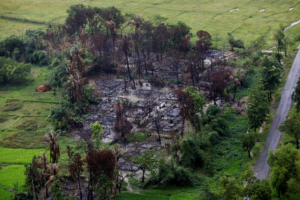
MYANMAR’S SECURITY NARRATIVE CANNOT EXCUSE GENOCIDE
For years, Myanmar’s military establishment portrayed its operations as necessary responses to insurgency and threats to national security.
The ICJ rejected that defense as an answer to the genocide allegations.
No state has the right to collectively punish an ethnic or religious population. No military commander may use an armed conflict to justify mass executions, rape, village destruction, or attacks on fleeing families.
The Rohingya people were denied citizenship, subjected to institutionalized discrimination, and deprived of fundamental freedoms long before the mass atrocities of 2017.
The judgment must therefore be understood not only as recognition of horrific crimes but as an indictment of the state conduct that enabled those crimes.
A uniform does not confer immunity. Military authority does not place perpetrators above international law.
THE ICJ HAS ORDERED CONSEQUENCES—NOT MERELY ISSUED CONDEMNATION
The Court’s ruling establishes obligations extending beyond recognition of genocide.
Myanmar has been directed to take immediate and effective steps concerning the investigation and punishment of persons responsible for genocidal acts.
The judgment also addresses the safe, voluntary, and dignified return of displaced Rohingya, the reunification of families, restitution of lost or damaged property, physical and psychological rehabilitation, and compensation for harm that cannot be remedied through restitution.
The amount and arrangements for compensation remain subject to further proceedings. Myanmar must also report within two years on restitution measures.
These obligations must not become empty words in another international document. They must be implemented, monitored, and enforced through available international mechanisms.
THE ARCHITECTS AND PERPETRATORS MUST FACE INDIVIDUAL CRIMINAL JUSTICE
The ICJ has determined Myanmar’s responsibility as a state. The pursuit of individual criminal responsibility must now advance through competent criminal courts and investigative authorities.
Those who planned, ordered, directed, encouraged, facilitated, or personally committed international crimes against the Rohingya must be investigated and, where the evidence warrants, prosecuted.
This includes senior military commanders, security officials, and other individuals implicated in the atrocities, without exemption for political position, military rank, or institutional authority.
The RSO calls for intensified support for the International Criminal Court, credible national proceedings under universal jurisdiction, and the Independent Investigative Mechanism for Myanmar.
The men responsible for genocide must not be permitted to retire into impunity, exercise political authority without accountability, or escape prosecution through their military connections.
THE TIME HAS COME TO PURSUE INTERNATIONAL CRIMINAL JUSTICE FOR ARAKAN ARMY ATROCITIES
The ICJ’s historic judgment against Myanmar must become a turning point for accountability for serious crimes committed against the Rohingya by all armed actors—including the Arakan Army (AA/ULA).
The RSO calls upon the United Nations, international prosecutors, independent investigators, and concerned governments to pursue accountability for alleged crimes committed by Arakan Army personnel and commanders.
The United Nations Independent Investigative Mechanism for Myanmar has already advanced investigations into serious international crimes allegedly committed by Arakan Army members.
Its 2026 report identifies evidence and allegations concerning:
• Sexual and gender-based violence, including rape against Rohingya women.
• Summary executions in Kyauktaw Township.
• Forced recruitment and use of children under 15.
• Destruction of Rohingya mosques and repurposing of religious land for non-Rohingya settlement.
• Clearance of Rohingya areas in Buthidaung and Maungdaw, contributing to further refugee movements into Bangladesh.
• Discriminatory language and practices resembling those used against the Rohingya during the 2017 military campaign.
These are grave matters requiring criminal investigation, identification of individual perpetrators, and examination of command responsibility.
The international community must not recognize genocide committed by one military establishment while overlooking credible evidence of comparable abuses by another armed force.
ARAKAN ARMY COMMANDERS MUST NOT BE ABOVE THE LAW
The Arakan Army’s military struggle against the Myanmar junta provides no legal justification for atrocities against Rohingya civilians.
Territorial control is not a license to persecute. Military victory does not grant ownership over another people’s ancestral homeland. Political ambitions cannot override international humanitarian law.
The RSO calls for the investigation of Arakan Army commanders and personnel suspected of ordering, enabling, or committing war crimes, crimes against humanity, or other international crimes.
Where jurisdiction and evidence permit, these individuals must face proceedings before the International Criminal Court or competent national courts. The United Nations Security Council should also consider referral mechanisms capable of addressing serious crimes throughout Myanmar.
Allegations of genocidal intent by any armed actor must be examined rigorously, independently, and in accordance with international law.
Changing the flag, uniform, or command structure does not change the nature of a crime. Those responsible must face justice, regardless of which armed organisation they serve.
THE ROHINGYA MUST NOT SUFFER ANOTHER CYCLE OF DESTRUCTION
The atrocities of 2017 must never be repeated under a different authority.
Today, Rohingya communities remaining in Arakan continue to face serious threats, including reported forced recruitment, restrictions on movement, arbitrary detention, forced labour, displacement, destruction of religious property, and barriers to humanitarian assistance.
The growing control exercised by the Arakan Army in parts of Arakan brings corresponding responsibilities for the protection of civilians.
No armed organisation may lawfully use territorial control to eliminate the rights, identity, homes, or future of the Rohingya people.
The international response must be guided by the crimes committed and the protection owed to victims—not by the political identity of the perpetrators.
AN INTERNATIONALLY MONITORED PROTECTION ARRANGEMENT IS URGENTLY REQUIRED
The RSO reiterates its call for effective international protection of Rohingya civilians, including serious consideration of a secure, internationally monitored protection arrangement in northern Arakan.
Any such arrangement must be established under an appropriate legal mandate, respect civilian rights, and prevent forced relocation or segregation.
It must guarantee physical security, humanitarian access, freedom of movement, protection of homes and religious institutions, and meaningful safeguards against renewed atrocities.
The Rohingya cannot be expected to return to the same insecurity from which they were forced to flee.
Repatriation without security is exposure to danger. Repatriation without citizenship is continued persecution. Repatriation without enforceable rights is not a durable solution.
RESTORE ROHINGYA CITIZENSHIP, LAND, HOMES, AND FUNDAMENTAL RIGHTS
The Rohingya belong to Arakan. Their historical connection to their homeland cannot be erased through discriminatory laws, destruction of villages, seizure of property, or organized displacement.
The RSO demands the restoration and protection of citizenship and legal identity, freedom of religion and movement, access to education and livelihoods, property restitution, and the right to return voluntarily in safety and dignity.
Effective remedies must include assistance for survivors of sexual violence, children deprived of education, families of those killed, and communities whose homes and livelihoods were destroyed.
Justice means more than acknowledgment of what was taken. It requires the restoration of rights and meaningful remedies for the harm inflicted.
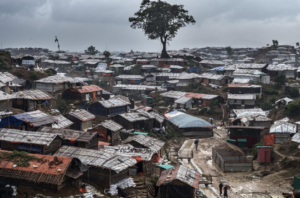
THE MUSLIM WORLD MUST NOW LEAD A NEW PHASE OF ACCOUNTABILITY
The RSO again expresses its deepest appreciation to The Gambia and the OIC for helping bring this historic case to judgment.
We now respectfully call upon Saudi Arabia, Türkiye, Bangladesh, Malaysia, Indonesia, Pakistan, Qatar, Nigeria, the Maldives, The Gambia, and all OIC member states to strengthen a coordinated international response.
That response should prioritize implementation of the ICJ judgment, accountability for perpetrators, investigation of contemporary abuses by the Arakan Army and other armed actors, protection for Rohingya civilians, sustained humanitarian support, and conditions for safe repatriation.
The Muslim world’s leadership helped achieve an extraordinary legal milestone.
The responsibility now is to help translate that milestone into protection, reparations, and lasting justice.
THE INTERNATIONAL COMMUNITY MUST ACT WITHOUT SELECTIVE JUSTICE
The RSO calls upon the UN Security Council, General Assembly, Human Rights Council, the European Union, ASEAN, and all concerned governments to place accountability and civilian protection at the center of their engagement with Myanmar and Arakan.
Investigations must be independent. Evidence must be preserved. Survivors must be protected. Perpetrators must be identified. Criminal responsibility must be determined through due process.
No government, military establishment, armed organisation, or political movement should receive immunity from scrutiny for grave violations of international law.
Justice that examines only yesterday’s perpetrators while ignoring today’s victims risks becoming another form of international failure.
OUR MESSAGE TO THE VICTIMS, SURVIVORS, AND FUTURE GENERATIONS
To every Rohingya mother who buried a child, every woman who survived sexual violence, every father who lost his family, every orphan who grew up in exile, and every refugee still waiting to return home:
Your suffering has not been erased. Your identity has not disappeared. Your rights have not expired.
This judgment cannot bring back the dead or reverse the years stolen from an entire generation. But it establishes a historic legal truth: the atrocities committed against the Rohingya constituted genocide.
We honor those who died, those who survived, and those who preserved the evidence despite intimidation, displacement, and hardship.
Their suffering demands more than sympathy. It demands justice with consequences.
FINAL DECLARATION OF THE ROHINGYA SOLIDARITY ORGANISATION
The Rohingya Solidarity Organisation welcomes the historic ICJ judgment as a defining milestone in the struggle for justice, dignity, and fundamental rights.
We express our enduring gratitude to The Gambia, the International Court of Justice, the OIC, the Muslim world, international supporters, investigators, human rights defenders, and courageous Rohingya survivors.
But our message to the international community is unequivocal:
Myanmar has been found responsible for genocide. Its obligations must be enforced.
Those individually responsible for the genocide must face criminal accountability.
The Arakan Army’s alleged atrocities must be investigated without delay, and perpetrators brought before competent courts.
The Rohingya must receive protection, restitution, reparations, citizenship rights, and the opportunity to return safely to their ancestral homeland.
We refuse to accept a future in which the Rohingya are recognized as victims of genocide yet remain permanently displaced, unprotected, and deprived of their rights.
THE WORLD HAS RECOGNIZED THE GENOCIDE. NOW IT MUST CONFRONT IMPUNITY.
NO PERPETRATOR ABOVE THE LAW. NO VICTIM BENEATH JUSTICE.
NO MORE GENOCIDE. NO MORE ETHNIC PERSECUTION. NO MORE FORCED DISPLACEMENT.
JUSTICE FOR THE DEAD. PROTECTION FOR THE LIVING. RIGHTS AND DIGNITY FOR THE NEXT GENERATION.
ROHINGYA BELONG IN ARAKAN.
Rohingya Solidarity Organisation (RSO)
19 November 2026